Bare ownership vs sale with guaranteed rent: key differences
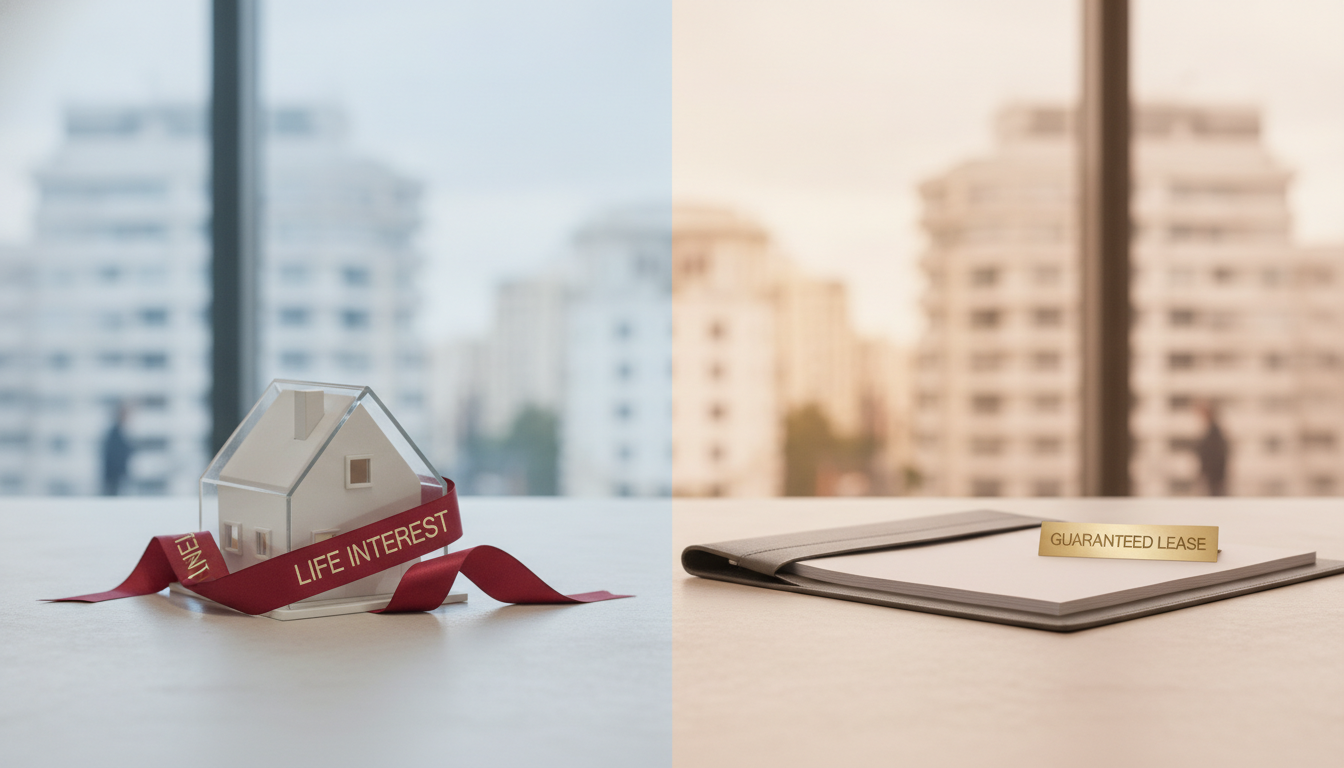
Both formulas share the same goal: releasing equity without having to move out immediately. The difference lies in the right you retain. With bare ownership, you remain as the usufructuary. In a sale with guaranteed rent, you sell full ownership and stay on as a tenant under an agreed tenancy agreement.
Making the wrong choice is not just a technical nuance: it changes your legal security, your monthly finances and what happens when the right of use ends.
What you sell in each case
Bare ownership: you transfer ownership, but retain the usufruct (usually for life). The buyer waits until that right ends to consolidate full ownership.
Sale with guaranteed rent: you sell the entire property and simultaneously sign a long-term lease with the new owner. You transition from owner to tenant according to the written terms.
In the first option, your safeguard is a right in rem (property right). In the second, it is a tenancy agreement. They sound similar in conversation ("I stay at home and receive the money"), but they are very different both at the Land Registry and in daily life.
Liquidity and price
In both transactions, the purchase price is usually below that of an unencumbered, vacant sale, as the buyer accepts that they will not have immediate use of the property. How much you receive depends on the market value, your age (especially in bare ownership with a life usufruct), the duration of the lease (in a sale with guaranteed rent) and negotiations.
There is no public table stating "at X years old you receive Y%". A professional approach requires a valuation of your property and your specific circumstances. Comparing the initial capital of a bare ownership offer with that of a sale with guaranteed rent without examining rent, expenses and time horizon is a classic mistake.
Residence: usufruct vs tenancy agreement
- Usufruct: a right in rem. For as long as it lasts, the bare owner cannot evict you to move in themselves. The limits and obligations are set out in the title deed.
- Guaranteed rent: a tenancy relationship. Your protection depends on the contract: duration, rent, rent reviews, maintenance works and grounds for termination.
If your priority is a long-term right of use (for life), bare ownership usually fits best. If you prefer to sell full ownership and arrange a lease with clear terms and rent, a sale with guaranteed rent is the most direct option.
Legal framework: Bare ownership versus sale with leaseback
A comparison of the legal concepts regulated under the Civil Code regarding the right to use the property following transfer.
| Criterion | Bare ownership with usufruct | Sale with subsequent leaseback |
|---|---|---|
| Legal nature of the right of use | In rem right of usufruct (Article 467 of the Civil Code). | Personal or contractual credit right (Article 1543 of the Civil Code). |
| Ownership transferred to the buyer | Bare ownership (use and enjoyment remain with the usufructuary). | Full ownership of the property (Article 348 of the Civil Code). |
| Grounds for termination of the right of use | Death of the usufructuary, expiry of the term, or causes set out in Article 513 of the Civil Code. | Grounds for termination or expiry under the contract and the Urban Tenancies Act. |
Criterion
Legal nature of the right of use
Bare ownership with usufruct
In rem right of usufruct (Article 467 of the Civil Code).
Sale with subsequent leaseback
Personal or contractual credit right (Article 1543 of the Civil Code).
Criterion
Ownership transferred to the buyer
Bare ownership with usufruct
Bare ownership (use and enjoyment remain with the usufructuary).
Sale with subsequent leaseback
Full ownership of the property (Article 348 of the Civil Code).
Criterion
Grounds for termination of the right of use
Bare ownership with usufruct
Death of the usufructuary, expiry of the term, or causes set out in Article 513 of the Civil Code.
Sale with subsequent leaseback
Grounds for termination or expiry under the contract and the Urban Tenancies Act.
Legal source extracted from the Civil Code and urban tenancies legislation.
Expenses and day-to-day living
In bare ownership, IBI tax, community fees and extraordinary repairs must be divided between the usufructuary and the bare owner. In a sale with guaranteed rent, you usually pay rent and, depending on the contract, certain tenant expenses, while the landlord assumes the rest.
In both cases: whatever is not in writing is not guaranteed. Ask for a schedule of obligations before falling in love with the cheque.
Inheritance and long-term outlook
With bare ownership, when the usufruct ends, the buyer consolidates full ownership; the property does not pass to the seller's heirs as full property. With a sale with guaranteed rent, as you have sold, you are no longer the owner: the estate receives the capital (or whatever remains of it), not the flat.
Neither option "solves" estate planning on its own, but both alter your wealth landscape in different ways. If there are several heirs or a complex will, it is best to review it with a lawyer before signing, not after.
How to choose in practice
Ask yourself three questions honestly:
- Do I primarily need a lump sum, or can I and do I want to pay a monthly rent?
- Is my priority a very robust life tenure, or is a well-negotiated long lease sufficient?
- Do I prefer to transfer only the bare ownership or liquidate full ownership right away?
If the answer regarding monthly rent is "I do not want to pay rent", a sale with guaranteed rent usually falls away. If the answer is "I want to sell everything, release substantial equity now, and the rent is affordable for me", a sale with guaranteed rent gains ground. If you want to retain a life usufruct and structure the payment (even as a life annuity payment method), bare ownership is the natural framework.
Profile and cities
Both options are primarily considered by people over 65. Sky Real Estate advises on bare ownership in Madrid, Mallorca and Valencia, and on sale with guaranteed rent also in Zaragoza.
If you wish to explore each formula further, read what bare ownership is and how a sale with guaranteed rent works. When the transaction requires it, Sky Law (European Legal Awards in Real Estate Law 2023-2025) reviews the deed and contract.
Frequently asked questions
What is the legal difference between bare ownership with usufruct and a sale with a subsequent leaseback?
Fuente: BOE, arts. 348, 467 y 1543 CC
How is full ownership consolidated following the termination of the usufruct in bare ownership?
Fuente: BOE, art. 513 CC
Who is responsible for paying annual charges and taxes during the usufruct?
Fuente: BOE, art. 504 CC